Introduction
What is a BBS?
A BBS (Bulletin Board System) is a computer system that hosts an online meeting place accessible over a network connection. Users connect to a BBS to interact through text-based menus, exchange messages locally or through networks, trade files, and play games. The first BBS, CBBS, was created in 1978 by Ward Christensen and Randy Suess in Chicago.
The BBS Documentary by Jason Scott provides a great introduction:
What is Telnet?
Telnet is one of the earliest network protocols still in use today. Developed for ARPANET in 1969 and described in RFC 97), it allowed systems to establish a two-way text-only connection over the internet. Telnet remains widely deployed and used all over the world and for embedded/IoT systems. Its longevity comes from its simplicity: it is portable, accessible, and easy to develop for.
Any client or server not capable of Telnet protocol negotiation is assumed to be limited to ASCII linemode communication, and so a BBS Server and client should negotiate at least SGA (Supress Go-Ahead) and BINARY to ensure for compatibility with retro BBS systems.
What is RLogin?
Many BBS servers and clients are connected to the internet by bridging serial with TCP/IP.
RLogin is even simpler than Telnet, providing a “remote-echoed, locally flow-controlled virtual terminal with proper flushing of output” which exactly matches the behavior of Serial Modem communication of which BBSs were originally targeted.
The RLogin protocol is only, “connect, optionally send credentials and terminal type, get an interactive shell”, and so even retro BBS servers bridged over TCP/IP that are not able to parse the client’s initial transmission are still otherwise compatible with the RLogin protocol.
Any BBS Server not able to negotiate Telnet is considered RLogin for this census.
See Also: MUDs
A companion website of MUD Telnet servers is at muds.modem.xyz.
BBSs are closely related to Multi-User Dungeons: both primarily use telnet, and are used to play games and chat, BBSs chiefly operate in character-at-a-time mode, while MUDs use line mode. Their preferred clients and servers are sometimes incompatible with each other.
Popular BBS door games, like Legend of the Red Dragon, Usurper, Trade Wars, Barren Realms Elite have similar gameplay, but game design differs due to time limitations to free the telephone line free for other “Callers”.
BBSing Today
During the 1980s and 1990s, tens of thousands of BBSs operated worldwide over telephone lines and modems. By the late ’90s, dial-up internet, graphics, E-mail, FTP, and the web browser rapidly displaced the use of the BBS in homes and workplaces.
Many still remain today and can be reached over telnet. Hobbyist Sysops continue to run BBSs on retrocomputers, like 16 or 32-bit IBM PC-DOS (CP437), 8-bit Atari (ATASCII), 8 and 16-bit Commodore (PETSCII, Topaz), and on modern 64-bit Linux and Windows PCs (UTF-8 [1]).
BBS Software is made by and for Sysops. Some people continue to write (and rewrite!) their own BBS Software to this day, in private and in small communities, targeting a specific retro computing platform, art style, or programming language.
Many of today’s BBSs are interlinked through message networks, such as fidonet, Zer0net, ArakNet, and fsxNet, though at significantly reduced volume compared to their heyday.
Client Software
The most popular open source clients with accurate font, color, and encoding presentation of Western BBS Systems are:
The author of this site has also authored a BBS Client, Telix.
Modern Terminals
Most any modern terminal will work for ASCII-only BBS systems, and any telnet client that may be installed or may already be present on your computer is fine. You might be surprised what strange devices you can telnet from!
Hint
Most BBSs require that you set a window size of 80 COLUMNS by 25 LINES,
or corruption of screen draws and cursor position can be expected.
Color correction
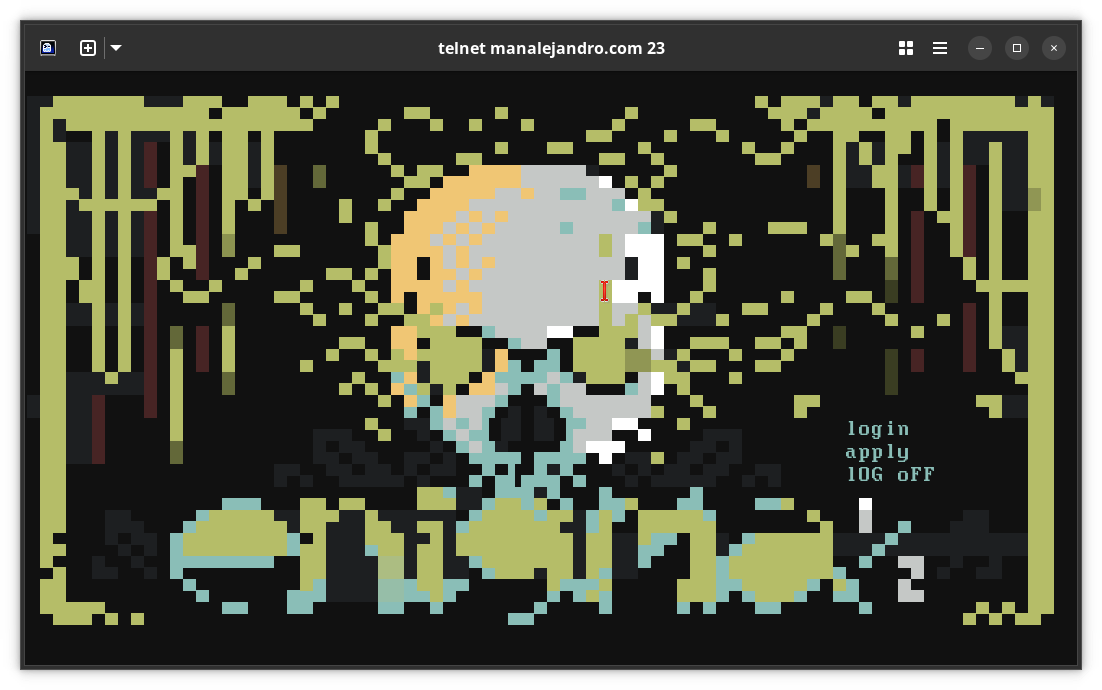
80x24 CP437 ANSI art of a skull with graffiti-stylized writing, “ENiGMA½”
Modern terminals often default to “Solarized” or reversed color palettes with disastrous results to the artwork and colors chosen for retrocomputers.
You should set the colors of your terminal to match something like the ANSI escape code colors. Even the default xterm colors differ. You can configure the first 16 colors used to match these colors somewhere in your Terminal’s settings. It is also suggested to enable “Bold as bright” when available.
Alternatively, the Telix project runs in a modern terminal and performs “color correction” by transliteration of ANSI color sequences to their 24-bit Color Sequences bypassing the palette and “bold as bright” options:
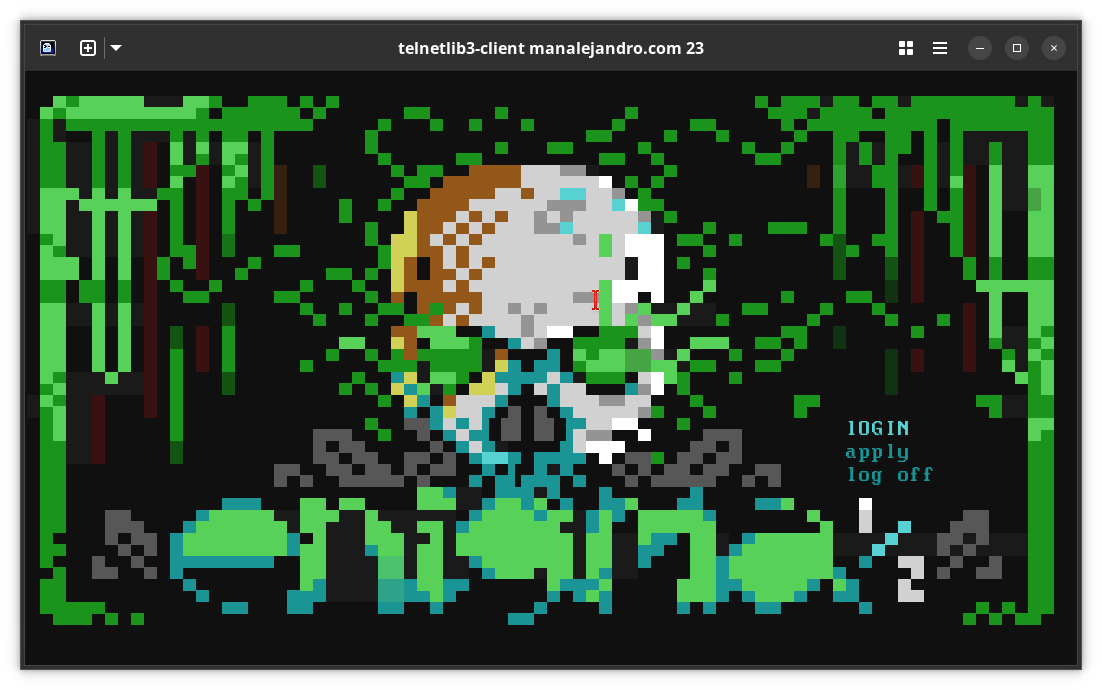
80x24 ANSI art of a skull and graffiti, color-corrected by Telix
Encoding correction
For systems that do not support UTF-8 [1], you may see encoding errors:
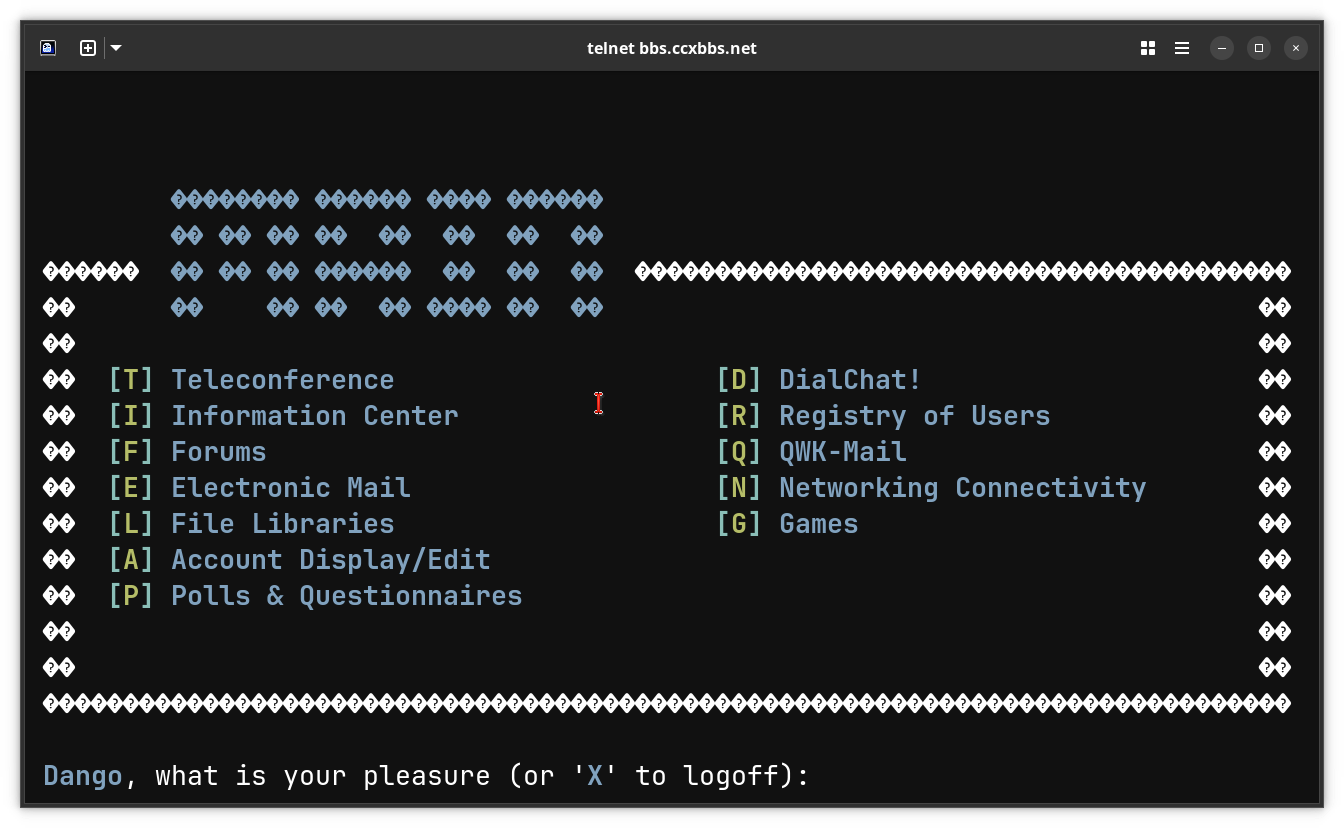
This “Main Menu” is meant to be stylized art, but contains encoding errors, marked by ‘�’.
cp437
The BBS Software pictured above advertised itself as MajorBBS; we can infer it is designed for IBM PC-DOS
(CP437) encoding, and can use the Telix option encoding=cp437 to correct for
it:
telix --bbs --encoding=cp437 bbs.ccxbbs.net
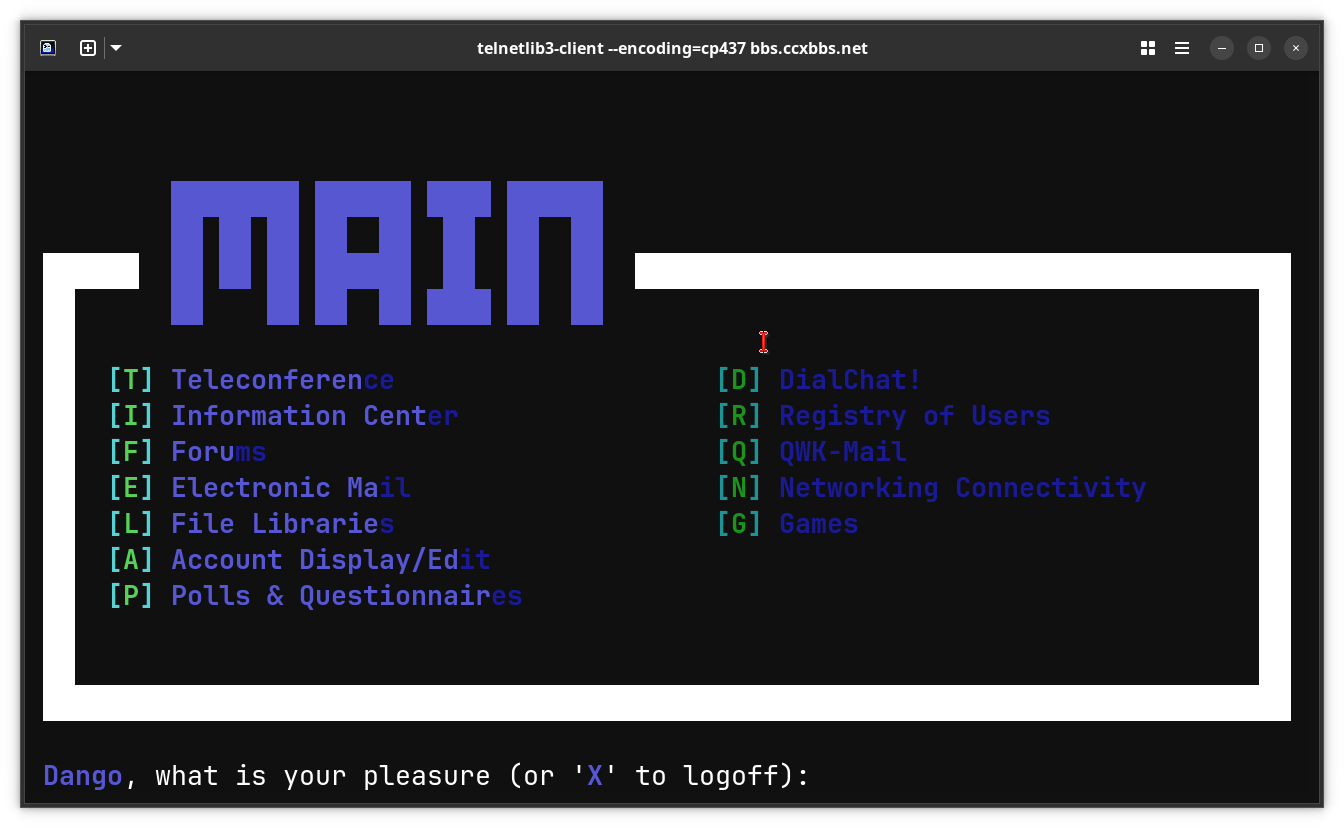
The Main title and border are now correctly displayed as “block art”.
Alternatively, a special BBS client, most popularly
topaz
Another BBS, this time Amiga:
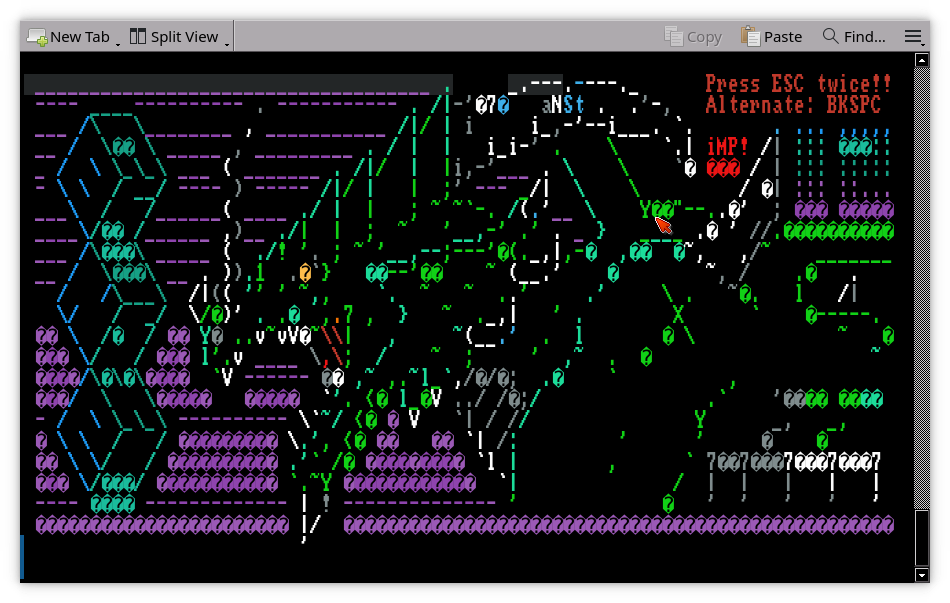
This Amiga art also contains encoding errors, marked by �.
The Amiga encoding is latin1 and can similarly be
fixed by Telix by setting the encoding=latin1:
telix --bbs --encoding=latin1 absinthebbs.net 1940
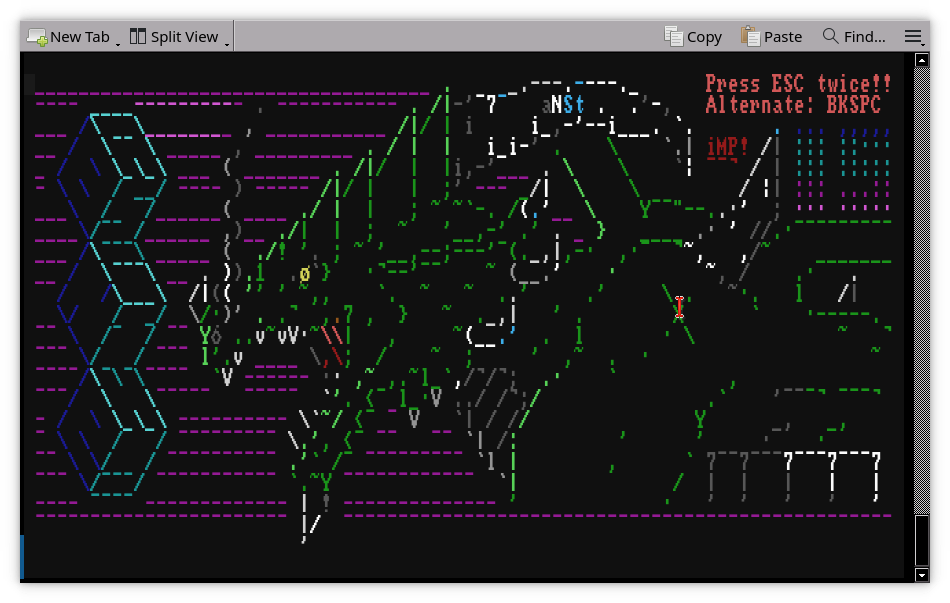
The same Amiga art now corrected by the encoding specified.
PETSCII
With the 8-bit Commodore PETSCII
Bescii-Mono.ttf font installed, Telix can perform bi-directional translation of PETSCII
PETSCII encoding and their control control codes:
telix --bbs --encoding=PETSCII valley64.com 6400
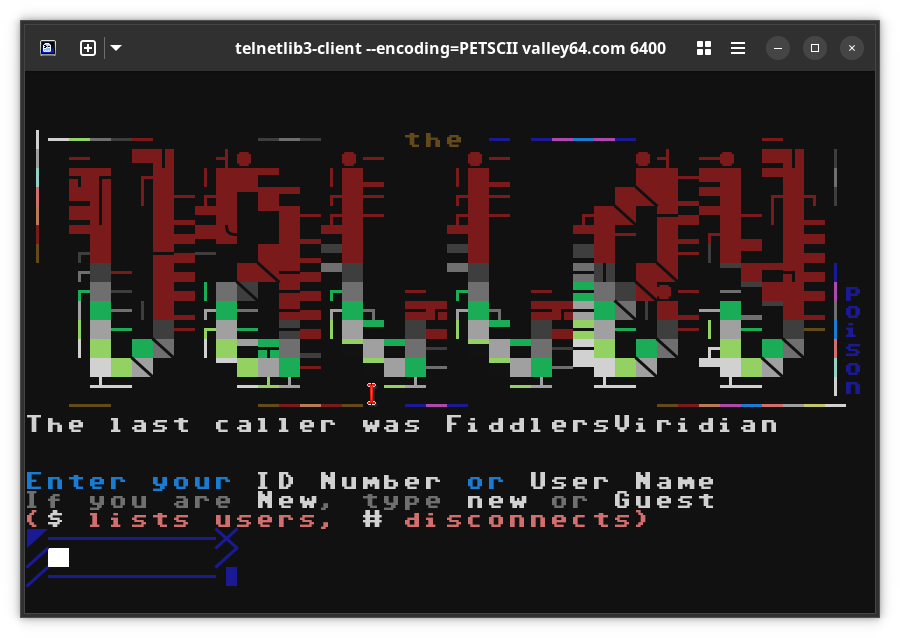
ghostty and Telix is used to connect to a Commodore BBS.
Hint
Most PETSCII BBSs require a window size of 40 COLUMNS
ATASCII
With the 8-bit Atari ASCII ATASCII EightBit
Atari-Classic.ttf font installed, Telix can perform bi-directional translation of
ATASCII encoding and their control codes:
telix --bbs --encoding=ATASCII area52.tk 5200
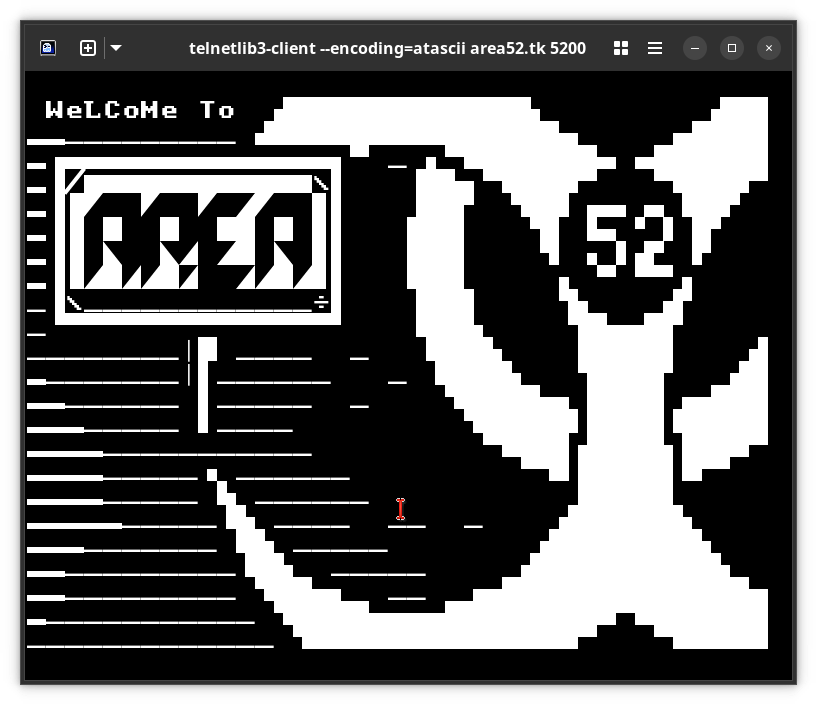
ghostty and Telix is used to connect to an Atari BBS.
Hint
Most ATASCII BBSs require a window size of 40 COLUMNS
Fonts
Though optional for IBM PC-DOS (CP437), as that artwork is faithfully reproduced, it is highly suggested to use a faithful font for ASCII-based 8-bit Atari (ATASCII), and 8 and 16-bit Commodore (PETSCII, Topaz) systems.
IBM-PC Code Page 437,
AcPlus_IBM_VGA_9x8.ttfCommodore Amiga Topaz,
amiga-topaz.ttf.8-bit Commodore PETSCII,
Bescii-Mono.ttf.Atari ASCII ATASCII,
EightBit Atari-Classic.ttf.
Server Software
A few BBS software packages continue to be developed, are open source, support UTF-8 [1], and are compatible with modern computers:
Synchronet BBS https://www.synchro.net/
ENiGMA½ https://enigma-bbs.github.io/
And some continue to be developed for retro computing platforms,
AmiExpress (Amiga)
About This Site
This site is a census of Telnet-accessible BBSs.
It provides a fast web interface to
Browse BBSs,
Preview login banners,
and examine their Telnet protocol details
This site is created by the author of Telix, A modern telnet client for BBSs and MUDs. This data is used to supply Telix with a default directory of available servers.
The data is gathered by the telnetlib3-fingerprint CLI to gather the results shown here.
This list of BBSs was primarily sourced from the IPTIA BBS Directory and the Telnet BBS Guide, cross-referenced against the MUD list maintained for muds.modem.xyz. SSH port data and BBS metadata (name, sysop, software, and website) comes from the Telnet BBS Guide’s monthly listing.
It is hosted on Github, and all documentation is auto-generated by code. Suggest a change to bbslist.txt to add or remove or fix an encoding as a pull request. Feel free to suggest any other changes or fixes.
Telnet banners are rendered using the fonts described above, with GNU Unifont as fallback for remaining Unicode coverage. Banner data is sent to WezTerm for a screenshot.
Better Sites
If you are looking for more comprehensive BBS directories, historical information, or ANSI art, these other sites are excellent resources:
Questions
Exercises for the reader!
How do BBSs differ from MUDs?
Why do BBS sign-ups ask for your location, birthdate, phone number, and gender?
Did you find a BBS with message areas? When was the last message posted?
Why is artwork so common? What common “themes” do you find in the art styles?
Why do BBS Servers require special clients?
Why were BBS so popular with piracy? What is a “WHQ” or a group distribution site?
Why is IBM PC-DOS (CP437) the most popular encoding behind ASCII?
Can you find the name of a historical BBSs that is no longer online?
Can you find a historical BBS that is still online today?
What kind of systems did BBSs run on? What do they run on now?
Why are so few BBSs on the IANA_designated port 23?